Buying mountain land can feel exciting right up until you realize how many details can affect whether a tract is truly usable. If you are looking near Banner Elk, a pretty view and a good price are only part of the story. You also need to understand access, utilities, slope, zoning, and timelines so you can make a smart decision with fewer surprises. Let’s dive in.
Start With Jurisdiction
One of the first questions to answer is simple: where is the tract actually located from a regulatory standpoint? Banner Elk is in Avery County, and the town’s zoning ordinance applies not only inside town limits but also in its extraterritorial jurisdiction, often called the ETJ.
That matters because the rules, review process, and development standards can change depending on whether the land is inside town limits, in the ETJ, or outside both. Before you go too far, confirm the parcel location using the town’s mapping resources, zoning map, county GIS, and flood mapping tools.
It is also smart to verify online parcel details against recorded deeds, plats, and other public records. Avery County notes that its parcel data is compiled from public records, but those source documents should be reviewed to confirm what is shown online.
Check Current Site Conditions Early
Mountain land always needs on-the-ground due diligence, and current conditions matter just as much as the map. Banner Elk reported that Hurricane Helene damaged homes, roads, businesses, and sewer and water lines on three sides of town, with repairs taking seven weeks.
For you as a land buyer, that is a practical reminder not to assume normal access, drainage, or utility service. Visit the tract, confirm road conditions, and ask direct questions about water, sewer, and any recent storm impacts before you move forward.
Evaluate Access Before Anything Else
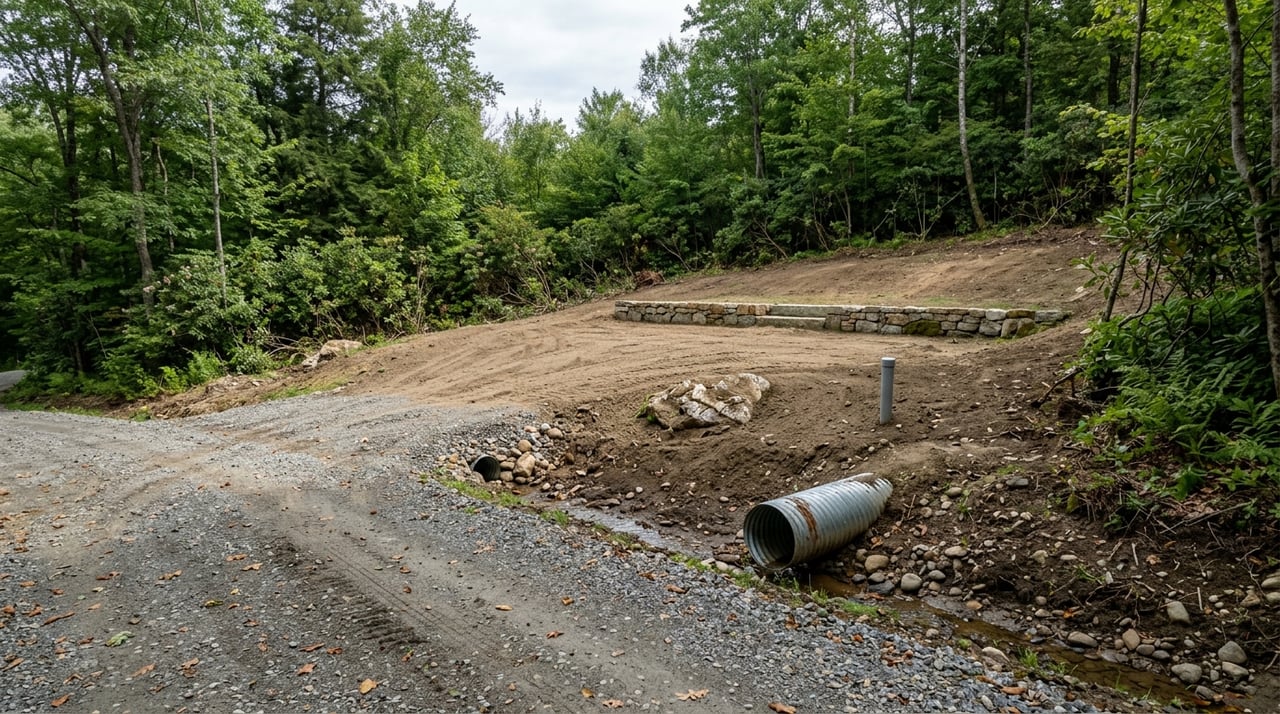
If a tract does not have workable access, the rest of the property may not matter. In the mountains, access can be one of the biggest make-or-break issues because steep grades, road frontage, driveway placement, and drainage all affect whether you can actually build.
North Carolina’s driveway permit process looks at traffic flow, design, drainage, traffic impacts, and safety. The state recommends coordinating first with the local land-use authority and the local NCDOT district engineer, which makes access one of the first items to investigate, not one of the last.
There is no application fee for a driveway permit, but timing still matters. Simple requests are often processed in about four weeks or less, while more complex requests can take eight weeks or more.
Another key point is that building permits are generally held up until the driveway access issue is resolved. If you are comparing multiple tracts, one with documented, workable access may save you significant time and uncertainty.
Access questions to ask
- Does the tract have confirmed legal and physical access?
- Is access from a state road, town street, private road, or recorded easement?
- Will a driveway permit be required?
- Are drainage improvements or culverts likely needed?
- Does the terrain make the driveway route unusually steep or expensive?
Confirm Boundaries and Site Layout
A mountain tract can look straightforward on a listing map and feel very different on the ground. Boundary lines, easements, road connections, drainage paths, and buildable areas should all be confirmed early.
Banner Elk’s zoning permit packet gives a good sense of what local review will focus on. Site plans may need to show setbacks, road connections, drainage, driveways, culverts, landscaping, unique land features, lighting, impervious surface, land disturbance, and stormwater mitigation.
If you are planning new construction or major improvements, the town says the site plan must be stamped by a certified engineer, architect, or surveyor. That makes a clean survey and early professional review especially valuable when you are deciding whether a tract is worth pursuing.
Understand Water and Sewer Options
Do not assume public utilities are available just because a parcel is near Banner Elk. The town states that its water system serves part of the area within town limits and only a minimal area outside town limits, while its wastewater system operates through a municipal sewer collection network and treatment plant.
If the tract is outside those service areas, you may be looking at a private well and septic system unless utility extension is possible. That can still work well, but it changes your due diligence checklist and often your timeline.
If public water or sewer extension is needed, Banner Elk requires utility plans to be submitted at least 45 days before board consideration. The town also reviews those extensions against its current Water and Sewer Master Plan, so this step can add meaningful time to the process.
Test Septic Feasibility, Not Just Possibility
For land outside public sewer service, septic suitability is one of the most important questions you can answer. Local environmental health guidance explains that the property needs to be marked and cleared enough for a site visit so the specialist can see the topography, setbacks, creeks, and property lines.
The evaluation looks at test pits, soils, topography, bedroom count, and the area needed for both the system and repair area. If soil or lot conditions are unsuitable, the department will explain other options, but the key takeaway is simple: a parcel is not truly build-ready just because it is vacant land.
You should also know that well and septic permits are typically valid for five years. Septic and well records may also be available through the local health department, which can be helpful if you are evaluating a parcel with prior approvals.
The septic process can also affect construction timing. The local guidance says the septic system’s operation permit must reach the building department before permanent electrical service is allowed on new construction.
Review Private Well Considerations
If you will need a private well, the site review should take more into account than just where the house might sit. Local guidance says the application should consider conditions on the site and nearby properties, including easements, rights of way, existing wells or springs, surface water or wetlands, tanks, landfills, waste storage, and known underground contamination.
North Carolina rules also require sampling of all new private drinking water wells installed since 2008 through local health departments. Toe River Health District says the typical time from sampling to results being mailed is about two to three weeks.
That is another reason to build extra time into your planning. In mountain markets, the tract that looks simple at first glance can still involve several separate approval and testing steps.
Pay Close Attention to Slope
Near Banner Elk, slope is not just a design issue. It can materially affect density, engineering requirements, construction costs, and how much of the tract is realistically usable.
Banner Elk’s code says average natural slope is used in density calculations. The code also states that parcels over 51% slope require a geotechnical engineer in multiple districts, which can increase both cost and pre-construction work.
The town’s site-plan checklist also asks for contour lines, average slope, average building elevation, retaining walls, and excavation areas. That is a strong sign that steep land often needs more analysis before you can confidently call it buildable.
Slope-related red flags
- Large portions of the tract appear difficult to walk
- Building sites require major retaining walls
- Driveway routing is limited
- Significant excavation looks likely
- Stormwater control may be more complicated
Know the Zoning Limits
Zoning shapes what you can build, where you can place it, and how much site work may be required. In Banner Elk’s primary residential districts, the dimensional table shows setbacks of 20 feet in the front, 10 feet on the side, and 10 feet in the rear.
Impervious surface limits also matter. The town’s packet says impervious surface includes roofs, buildings, patios, sidewalks, parking lots, and roads or driveways made of asphalt, concrete, or gravel, and the code caps impervious surface at 45% in R-1, R-1-U, and R-2.
That can affect your house footprint, driveway design, parking areas, and any future additions. A tract may have enough acreage on paper but still have practical limitations once slope, setbacks, and impervious surface caps are applied together.
If You Might Subdivide, Study the Rules Now
If your plan includes dividing the land, adding multiple homesites, or developing in phases, subdivision rules should be part of your early review. Banner Elk requires a preliminary plat prepared by a registered surveyor or civil engineer.
That plat must show boundaries, adjoining owners, easements, utilities, flood hazard areas, drainage, and riparian buffers. If the development will happen in phases, the town also requires a master plan showing the full subdivision, proposed density, streets, utilities, and a development timetable.
Street planning matters too. The code says streets within subdivision jurisdiction generally must be dedicated to the public, although private streets may be approved in certain situations. Private streets also require a recorded maintenance agreement, and proposed street design is subject to DOT review.
Build-Out Timelines Are Often Longer Than Buyers Expect
Many land buyers focus on the purchase and underestimate the timeline to get from raw tract to build-ready site. Near Banner Elk, the most common early bottlenecks are driveway access, septic or well feasibility, utility extension, and any subdivision or special-use review.
Banner Elk requires subdivision applications and special-use site plans to be submitted at least 30 days before the board meeting. Utility-extension plans require at least 45 days before consideration, and driveway permits can take four weeks or more depending on complexity.
That does not mean a tract is a bad opportunity. It just means you should evaluate land based on both price and process.
What Helps a Tract Hold Resale Appeal
From a resale perspective, buyers and builders usually respond best to land with fewer open questions. A tract tends to be more marketable when it has documented access, a clear survey and boundary picture, a workable septic or utility path, and a site plan that fits local slope and impervious surface rules.
That is not a formal pricing formula, but it reflects the practical risks future buyers will likely review before making an offer. In other words, the easier it is to understand a tract, the easier it may be to sell later.
Smart Professionals to Bring In Early
The right team can save you time, money, and frustration. Depending on the tract, these are the professionals most worth involving early:
- Registered surveyor or civil engineer for site-plan or preliminary-plat requirements
- Environmental health specialist and septic installer for soils, test pits, and septic feasibility
- NCDOT district engineer for driveway access review
- Geotechnical engineer for steep parcels where slope may trigger additional analysis
If you are buying from out of town, having a responsive local guide matters even more. A land purchase near Banner Elk often moves best when you treat due diligence like a step-by-step project, not a quick guess.
If you are considering acreage or a homesite near Banner Elk, working with someone who understands both the listing side and the practical build questions can make the process much smoother. Lori Teppara offers hands-on guidance for land, mountain homes, second-home purchases, and investment property across the High Country, so you can move forward with more clarity and confidence.
FAQs
What should I check first when buying land near Banner Elk?
- Start by confirming whether the tract is inside Banner Elk town limits, in the ETJ, or outside both, then verify access, zoning, utilities, slope, and site conditions.
Does every Banner Elk area tract have public water and sewer?
- No. Banner Elk says water service covers part of the town area and only a minimal area outside town limits, so many tracts may need private well and septic unless an extension is feasible.
Why is driveway access such a big issue for Banner Elk land?
- Driveway access affects safety, drainage, and buildability, and NCDOT says building permits are generally withheld until driveway access is resolved.
How do I know if a tract near Banner Elk can support a septic system?
- A local environmental health specialist evaluates marked and cleared property using test pits, soils, topography, setbacks, and bedroom count to determine septic feasibility and sizing.
Can steep land near Banner Elk still be buildable?
- Yes, but slope can affect density, engineering requirements, construction complexity, and timelines, and parcels over 51% slope may require a geotechnical engineer in multiple districts.
What makes a land tract more appealing for future resale near Banner Elk?
- Tracts with documented access, clear boundaries, a realistic septic or utility path, and site plans that fit local rules are generally easier for future buyers and builders to evaluate.